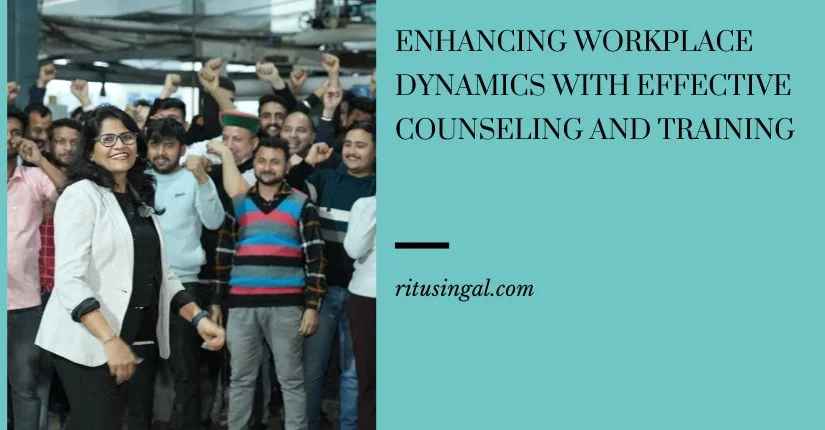
In this insightful article, I discuss how stress impacts the modern workforce and how the benefits of stress management training and senior management training can help combat such detrimental issues.
The benefits of Stress Management Training
The word ‘stress’ is more commonplace than we think it is. The feeling of not being able to fit everything in one day, demanding family responsibilities, and financial and physical well-being can become daunting very fast.
Stress at the workplace is another concern affecting individuals across the globe.
The prevalence of the hustle culture, poor work-life balance, soaring inflation rates, and the constant pressure to stand out cause havoc to both productivity and mental health, leading to a phenomenon called ‘Quiet Quitting’.
A report by Gallup suggests that employee stress at the workplace remains at a record high, even with increased job opportunities worldwide.
I am Ritu Singal, a life coach and certified trainer with experience in different domains ( manufacturing, finance, education, women empowerment, child abuse, HR etc ), and I have helped thousands of individuals cope with stress and lead happier and empowred lives.
In my experience, some of the indirect impacts of workplace stress that I have seen individuals face, include:
Lack of focus and inability to get anything done
Lack of patience with others
Always feeling overwhelmed and anxious
Bouts of depression, sadness, and lack of control
When the job market opened up post-pandemic, we saw high resignation rates.
MUST WATCH
Evidently, people wanted to move out of their workplace due to less pay, dwindling economic conditions, and a lack of opportunities.
Many companies today have incorporated stress management training in their mandatory policies for employees and have also started focussing on senior management training to cope with such detrimental stress conditions.
In this article, I will delve into the benefits of stress management training at the workplace and how senior management has a crucial role to play in this area.
Stress Management Training and its benefits
I have often seen people consider stress management as a taboo.
However, the real goal of stress management training is to be alert and responsive to stress triggers and develop proactive measures for handling stressful situations.
In my experience, the benefits of stress management training that I’ve personally seen are as follows:
Increase in employee engagement rates: The concept of ‘quiet quitting’ is a phenomenon where people tend to feel lost, less focused, and demotivated at work. Even though they are logged in, most of the time they are either unsure of what needs to be done, or suffer from lack of opportunities.
Many employees even fail to discuss such scenarios with their supervisors or peers, suffering in silence and detaching themselves from social circles.
I have helped people over the years with strategic coping mechanisms and a dedicated support system that helps to boost productivity.
Less absenteeism and reduced employee turnover: Employee turnover is a serious problem impacting companies post-pandemic. Hiring talent is becoming difficult day by day because employees have come to realise the importance of a lifestyle beyond high pay alone.
These include work-life balance, job security, paid leaves, and hybrid benefits.
Lesser workplace conflicts:I have seen people engage in conflicts with seniors and colleagues that are often perceived as harmful. With a dedicated person certified and trained in counselling, the employee feels a lot more secure and confident and approaches daily matters objectively.
Role of Senior management in employee stress management:
The role of senior management in handling stress is often underrated. These are the people who are regularly interacting with their subordinates and are responsible for closely monitoring their performance and well-being.
A positive manager-employee relationship can go a long way and prove to be helpful in the following ways:
Smooth career growth
Clarity of work purpose and directed efforts towards getting work done.
Understanding employee bandwidth, thereby reducing stress and excess workload.
Growth aspirations, fair increments, and timely promotions.
Stable work-life balance and mentorship at work
Some of the ways by which senior management and senior management training can help manage stress among team members are listed below:
Frequent 1 on 1’s – With work from home culture taking prevalence, it has become all the more important to engage in frequent 1 on 1’s with team members.
This helps the supervisor understand employee aspirations and career growth, any important issues they may be dealing with, such as a hateful comment or an unprofessional colleague, and many other issues often kept under wraps.
Managers are often considered trying to ‘get back’ to their employees during appraisals or promotions. As humans, at times, emotions creep in and impact fair assessment.
With senior management training, I help managers objectively assess their subordinates, build on their strengths and provide feedback when needed.
Develop a comprehensive training program around stress management –
A stress management program that is mandated for all employees in a collaborative atmosphere helps individuals understand stress triggers and cope in times of crisis and overwhelming family and work responsibilities.
Implementing recognition programs – Recognition programs that keep track of employee progress and compensate performing individuals , often act as energy and stress boosters.
As a corporate counsellor, I have designed various recognition programs and helped to break the news of a significant promotion or critical feedback to an employee.
Open Door policy – There is often a disconnect that is seen among supervisors and team members because of a ‘holier than thou’ attitude or simply because the manager is less approachable and/or adorns a sense of pride and unreasonable authority.
This is often seen in corporate environments where employees feel insecure and often face fear of job security.
Having an open door policy, where employees can walk up to and discuss their work or personal problems and brainstorm solutions with their trusted mentor, can easily become a stress booster.
The famous quote that says ‘ Lead by Example,’ is also something managers should consider. Trying to impose norms and work expectations from subordinates that they don’t follow creates mistrust.
Senior managers need to motivate team members through their knowledge, experience, and value systems, not by imposing work norms that kill creativity and undermine the flexibility of operations.
How does a stress management consultation help?
Chronic stress needs to be treated without delay. Instead of turning to negative habits like smoking, drinking, shopping, stress eating, and other forms of unhealthy coping mechanisms, it is vital to seek professional support.
For the longest time, I, Ritu Singal, have seen individuals feel stressed and anxious before an interview or a crucial promotion and feel intimidated by an overpowering personality or by a colleague who throws an attitude.
As a provider of corporate counselling services, I first try to understand the challenges confronting your company through focus group discussions, analysing current requirements and prevailing market trends. Once these issues are identified, I tailor plans to help your organisation navigate and overcome these challenges.
A stress management consultation program helps identify the underlying causes of stress, be it workplace or personal, and suggests mechanisms tailor-made for an individual’s specific needs and traits. However, choosing the correct mentor, who keeps privacy and empathy as a top priority, is the right way to go.
Most people think that stress is manageable and will go away on its own.
But it doesn’t.
To conclude, smart individuals who care for their well-being before anyone else’s can easily combat life’s unforeseen stress and stay motivated and mentally healthy through professional help.
How are you coping with everyday stress?
If you are one of those, who has stayed under the wraps for too long and hoping to break free from this pattern, finding a suitable program and seeking help is the way to go!
In this insightful article, I discuss how stress impacts the modern workforce and how the benefits of stress management training […]
Who is a leader, and why is management required in an organization?
Being a leader is something that everybody looks forward to. I have met young professionals and seen that burning desire in them. Yet when they reach the position of leadership, things fail. Why?
It is because the basics such as decision-making, time management, strategic planning and are not polished. On the surface, everything appears to be fine, but deep down, strategies are missing.
As a leader who has inspired and guided a team towards achieving objectives, I believe the team that operates efficiently is the leader who makes every team member feel seen and heard.
However, each organization has different values. Hence, you must ensure that it aligns with the organisation’s goals. Remember, you do not have to agree to whatever they say, you just have to make them feel that their opinion matters.
I know this because I have trained several good managers. They motivate and inspire their team members to give their best and put in all their efforts. That’s just the beginning..
Senior Management Training requires more than that. But why do you need senior management training you may ask..It equips individuals with the knowledge and skills to become effective leaders and managers.
With the right training, individuals can learn how to manage their time effectively, communicate with their team members, and make informed decisions that benefit the organisation. Led personally by me, Ritu Singal, our program is designed to provide individuals with the tools they need to excel in their roles and drive their teams towards success.
MUST WATCH
How does it help not only the employees but also the organisation?
It’s no secret that senior management training can be a highly effective way for employees to learn new strategies and techniques to improve their own and organizational performance. This type of training can help employees feel like they are continually growing their skills, which in turn makes them better suited for their leadership roles. Implementing new strategies and techniques in their roles can also help employees become more productive, focused and successful.
Senior management training can help identify high-potential employees and create opportunities for employees to reach their full potential. By working towards their goals, employees become more motivated and driven towards performance. Ask any of my clients and they can vouch for it.I have helped companies from scratch.
What is the role of a senior management consultant?
If you go by the book ,A senior management consultant is a professional who provides expert advice and guidance to organisations on various management aspects, such as
Strategy
operations,
and organisational structure.
They work with senior management teams to identify problems, develop solutions, and implement changes that improve performance and drive growth.
They provide training and support to management teams, and this training helps a senior management trainee develop the skills and knowledge necessary to lead their teams effectively. Their role involves actively analyzing the organization’s current situation, identifying areas of improvement, and recommending strategies to achieve the desired outcomes.
Yes, it is true, but without a value-driven approach, one can not succeed . That’s what the books and several courses don’t tell you . Does your senior management trainee operate on values?
Do they put the interest of the company first? Do they know how to keep competition aside and teach their people how to grow? I have encountered many senior management trainees who are afraid that they might not be promoted if they let others grow.That’s why in my approach, I teach people how to succeed while making others successful
The books also state that A senior management trainee must also bring a wealth of experience and knowledge to the table. He /She must upgrade to hold the consultant position, having worked with various organisations across different industries. Plus, also assess complex situations, identify key issues, and develop solutions that deliver results.
In my experience, I noticed that two senior management trainees can have opposite strengths and weaknesses. Yet they portray their weakness as their strength. Some of them can also not embrace their uniqueness because of their desire to fit in. In certain cases, it may be because of their fear of losing their position. I help them overcome this fear and lead successfully.
Lets now delve into how scheduled training helps develop the required skills for a senior manager:
Developing in-house talent can be a more cost-effective way of filling senior management positions than recruiting new hires.
When you recruit new team members, they expect higher salaries. Plus, you need to invest costs on advertising, recruitment, travel, and relocation expenses. Thus you get to save a lot of money on this. As an entrepreneur of three companies, I can tell you that this is 100% profitable
Poor leadership leads to employee turnover
Poor leadership is a common reason for employee turnover. Employees leave when they do not feel supported, valued and a part of the organisation’s growth. To sustain them, one must instill a sense of belonging in them.
Good leadership is a fine balance between natural qualities and training.
Organizations should focus on identifying individuals who have these qualities and provide them with leadership training to support succession planning. This will offer higher career pathways and help nurture future leadership.
Senior management training sends a powerful message that the organization values and cares about its people.
It can inspire better performance and foster a sense of loyalty. This type of mentoring can significantly improve employee morale and ultimately make the organization a great place to work, leading to a better corporate culture.
Effective leadership is essential during challenging times, such as drastic changes, layoffs, restructuring, upheavals, and increased competition.
Senior management training can help companies navigate these times by improving their response to an unpredictable environment. It can also help organizations become more agile and adaptable to the market’s changing needs.
When senior managers have greater clarity, direction, and time management, these traits trickle down to their followers.
MUST WATCH
The above fosters greater motivation and organizational effectiveness, leading to an efficient and effective work team. Overall, senior management training is a crucial investment in the organisation’s future growth and success, and it’s a win-win for everyone involved.
I and several other successful entrepreneurs can vouch for the above. The best companies in the world are formed through great leadership. Even religion follows great leadership.
Thus , in modern times, creating a culture of respect and inclusivity in the workplace is crucial. It’s important that everyone feels valued and supported. Moreover, senior managers should know the latest HR practices and regulations to ensure compliance and avoid legal issues.
In conclusion, there is a lot more than what meets the eye when it comes to senior management-level training. I, Ritu Singal can help you bridge the gap between good and great. Are you ready to take your organisation to the next level? Then you can contact us anytime.
Who is a leader, and why is management required in an organization? Being a leader is something that everybody looks […]
In today’s world, relationships are more complex than ever before. The pressures of career, personal goals, and societal expectations can take a toll on even the strongest of partnerships. Couples often find themselves struggling with challenges they never anticipated—issues that can lead to misunderstandings, emotional distance, or even resentment. This is where couples counseling steps in as a vital resource, offering guidance and support for modern relationship problems.
As a life coach specializing in marriage counseling, I, Ritu Singal, aim to shed light on the transformative power of couples counseling. It’s not just about addressing problems but about building stronger, more resilient partnerships that can weather the storms of life together. So, if you’re ready to discover how couples counseling can help you navigate the complexities of modern relationships, let’s dive in!
Understanding Modern Relationship Problems
Modern relationships face unique challenges that previous generations may not have encountered. From the increased use of technology that can create distance to the pressure of achieving “relationship goals” portrayed on social media, couples today are navigating a landscape filled with potential stressors. These issues can lead to communication breakdowns, unmet expectations, and conflicts that might seem insurmountable.
Communication Issues: With busy schedules and digital distractions, genuine face-to-face communication can sometimes feel like a lost art. Misunderstandings and assumptions can lead to resentment over time.
Balancing Career and Personal Life: Many couples struggle with finding the right balance between their professional and personal lives. High-stress jobs can lead to emotional exhaustion, which inevitably affects the quality of time spent with a partner.
Diverging Personal Goals: In an age of personal growth and self-discovery, couples may find themselves growing in different directions. This can lead to feelings of disconnect and uncertainty about the future.
It’s easy to feel overwhelmed by these issues. But the truth is, modern relationship problems don’t have to be the end of a relationship—they can be a powerful opportunity for growth and deeper connection. And this is where couples counseling becomes a game-changer.
The Power of Marriage Counseling
Marriage counseling, or couples counseling, provides a safe and supportive environment for partners to explore their feelings, improve communication, and find solutions to their problems. It’s not just for couples on the brink of separation; it’s for any couple who wants to strengthen their bond, address underlying issues, and work towards a healthier, more fulfilling relationship.
As a life coach, I approach marriage counseling with a blend of empathy and practical strategies. Marriage counseling is about more than just resolving conflicts—it’s about helping couples develop a shared vision for the future. Through counseling, couples can:
Improve Communication: Counseling offers tools and techniques to help partners communicate more effectively, fostering a deeper understanding of each other’s needs and perspectives.
Rediscover Intimacy and Connection: In the hustle and bustle of daily life, it’s easy for couples to lose touch with the romance and connection that brought them together in the first place. Counseling helps couples reignite that spark by addressing issues that may have created emotional distance.
Align Goals and Values: Counseling helps partners work through any differences in their long-term goals, ensuring that they’re moving forward with a sense of shared purpose and unity.
Marriage counseling transforms the relationship by creating an environment where both partners feel heard, valued, and respected. It encourages open dialogue and helps couples rebuild trust and intimacy, laying the foundation for a resilient and lasting relationship.
How Ritu Singal’s Approach to Couples Counseling Stands Out
When it comes to navigating the complexities of modern relationships, Ritu Singal’s approach to couples counseling is both compassionate and results-oriented. I believe that every relationship has unique challenges and strengths, and I tailor my counseling approach to meet each couple’s individual needs.
MUST WATCH
My approach to couples counseling incorporates principles from life coaching, which means I not only help couples address current issues but also equip them with the skills they need to thrive in the future. By integrating life coaching into marriage counseling, I encourage couples to work on personal growth alongside their relationship growth. After all, a thriving relationship often involves two thriving individuals.
One of my key strategies is helping couples identify the root causes of their conflicts. Whether it’s unresolved past issues, misaligned expectations, or external stressors, I work with couples to uncover the deeper issues at play. From there, we focus on building practical solutions that will allow them to navigate these challenges as a team.
In conclusion, couples counseling is a powerful tool for building a healthy, lasting relationship in today’s complex world. By addressing modern relationship problems and fostering better communication, marriage counseling helps couples create a strong, resilient partnership that can stand the test of time. With guidance from a life coach like Ritu Singal, you can not only overcome your current challenges but also create a relationship that continues to grow and evolve.
If you and your partner are ready to take the next step towards a healthier, more fulfilling relationship, consider couples counseling as an investment in your future together. The journey might not always be easy, but with the right support, it can lead to a stronger, deeper connection that brings lasting happiness.
In today’s world, relationships are more complex than ever before. The pressures of career, personal goals, and societal expectations can […]
Strategies to increase productivity at the workplace – “Work smarter, Not Harder”
Do you find it hard to concentrate on a certain job? Do you find yourself in the middle of a mess when so much work is yet to be done? Are you wondering if you really are cut out for this?
If so, then it’s time for you to learn something new. You need to discover more about how to stay and increase productivity at the workplace when the universe is asking a lot from you.
Increasing productivity at the workplace is more than important, especially when you are in a competitive business world. In the modern fast-paced environment, it can make your career or even destroy it. In case you are not ready to make yourself productive no matter the time or place, you are not going to make the finish line.
So you need to learn the tricks about how to make yourself useful without burning out. In this article, you are going to learn a lot more about what productivity is, why it is important, and how to increase productivity at the workplace.
What is workplace productivity?
First of all, productivity is not about working long hours or working harder than you normally do. It’s about accomplishing more in less time without getting distracted from your goals.
Just because someone is working late nights or 7 to 8 hours long without taking a break, that doesn’t mean they are working efficiently. This could be overwhelming for you in case you continue to work even if your body and mind are not fully into it. In that case, you are not being productive, you are suffering from burnout which will affect your ability to work in the future.
Now, what does it mean to have workplace productivity?
Workplace productivity is about delivering high-quality work within the deadlines by fully utilizing your time and skills. In order to increase productivity at the workplace, you need to have a clear idea about what your work goals are, how to reach those efficiently, and how to maintain a work-life balance.
Let us understand this through a story.
A man came to the king asking for a job. The king accepted his application and kept him on a job for rs. 5000 per month in the palace. He started working for the honorable king in the palace. After a few days he noticed that there is another man working in the palace with the same designation but he is getting paid Rs.20,000 per month. He felt very bad about it. This man went to the king and complained about injustice happening to him. The king consoled him by saying that he will look after it.
Few days passed. One day some kind of noise was coming into the palace from outside. This man was standing there so the king asked him to check what was happening there. The man went outside and came back with the answer that few people had gathered outside and made that noise.
The king again asked him who those people were. The man again went outside in search of an answer and came back. He answered that they were coming from Rajasthan and wore some monk style saffron-colored clothes. The king again asked in wonder, “What are they doing?
The man again went outside and came back with the answer that they play orchestra. The king questioned how much they charge for it. Again the man went outside and came back with the answer that they charge Rs. 10,000 for this. Then the king asked him the last question: how much will they charge for him? And again the man went outside and came back with the answer that they will charge Rs. 6000 for the king.
Now The king summoned the other man who was working with the same designation. And asked him one question to check what kind of noise was happening outside the palace. He went outside and came back to the king within a few minutes. He told the king that those people were coming somewhere from Rajasthan.
They have worn the monk style saffron coloured clothes and are doing the job of musician and singer as they have musical instruments. They usually charge Rs. 10,000 but for the king they will do the job for Rs. 6,000. He bargained with them and made them do the job for Rs. 4000 for the king. Now the man learned his lesson, accepted his mistake and apologized for the same.
That man has understood that they both were getting their payments according to their productivity. You have to manage multiple things at the same time and increase your productivity. For increasing your productivity you need to understand the interlinked work and complete them in one go.
You need to do the analysis and understand your work patterns thoroughly. You need to understand how much effort, passion and dedication you are putting into your work. try to focus on increasing your productivity and you will get the raise and appreciation at your workplace automatically.
To increase productivity at the workplace., you can take certain actions. Later in this article, you will learn about these actions in detail. But for now, let’s just say that ensuring productivity has more than one benefit that you might have never thought of before.
What are the different types of productivity
No matter what your working levels are, you need to be productive at all times. Especially after COVID, so many companies and Organizations are leaning towards remote or a hybrid working environment. In that case, you need to be efficient, complete tasks within a certain deadline, and achieve short-term goals without fail.
The concept of productivity is not always the same in every working arena. By exploring all the different types of productivity, you will have so many different perspectives as well.
Personal Productivity
Personal productivity focuses on how quickly you are able to finish your work without compromising quality. However, doing it is not as easy as it sounds. You might not achieve this ability all of a sudden, but surely you can get there with a bit of practice.
When you have to be productive on a personal level, you must set your priorities right. Next comes time management techniques which need a lot of thinking about which task seems the easiest to complete. Developing good habits like continuing to learn new things, and keeping away from modern-day distractions like checking social media every now and then also helps.
MUST WATCH
Team Productivity
These days mostly you have to collaborate with your team members for a project. In that case, you have work to do in order to complete the project. You need to know exactly what your role is going to be and how you maintain the responsibility that is given to you.
Team productivity means that you have to value the team members, engage in open conversations with them, and nurture a positive work environment. You won’t be able to get anything done in case you don’t value the contributions of each member.
Organizational Productivity
When you work for an organization, you need to be more efficient since your productivity eventually leads to the growth of that particular Organization. It means how efficiently an organization is utilizing the resources to achieve its goals. However, some Organizations don’t include strong leadership, and as a result, they fail to plan strategically.
Every Organization needs to have a healthy work environment to encourage innovative ideas. The more the employees will engage in exploring new perspectives, the more improvement it would be for the Organization. Even the corporate counseling programs are available nowadays. organizations are taking interest and avail corporate counseling programs for maintaining healthy and productive health culture.
Economic Productivity
Economic productivity is necessary for economic growth and prosperity. It involves enhancing the efficiency of how fast the production process is going. It also includes innovations of new technologies and utilizing each and every resource.
It can be tracked by the output of goods produced per unit input such as capital, labor, or time. These inputs are absolutely necessary for the advancement of the economy.
Business Productivity
When it comes to a business, productivity is important as it tracks how efficiently the revenue is coming. It involves measuring the work hours to the amount of revenue. This is essential to earn a profit, to have healthy competition between the competitors, and to get long-term success.
National productivity becomes more than important now that it determines exactly how the natives will lead their life. A country needs to generate products and services using minimum labor and materials. If a country fails to do that, the citizens will suffer.
A country that always looks to invent new technologies tends to increase its economic growth. It also directly affects the other significant aspects when it comes to running a country.
Why productivity is important?
Companies across all industries demand workplace productivity as it is of utmost importance. They provide you with a certain timeframe, and you need to accomplish your task within it. Your actions directly affect how the company will perform when it comes to staying one step ahead of the competitors.
All of these could be too much to process at once for you. In the following, you will find a short discussion about why workplace productivity is very crucial.
It enhances efficiency
When you as an employee are productive and can complete your task within deadlines, it means that you’re utilizing resources like a pro. This means that you are being efficient which helps improve the overall performance of the company. It allows any organization or business to achieve more in less time, exactly what they look for.
It ultimately results in increased revenue
People wouldn’t be talking about productivity so highly if it weren’t for the increased revenue of a company. When the employees work like a pro, and complete tasks within a time frame, they are ultimately helping the company to get more profit. If you know how to use resources for good, it can reduce costs and boost the business.
A company can only advance toward financial growth and sustainability if the employees generate more input. All these directly increase revenue for sure.
It helps companies to stay ahead of others
These days any company won’t be able to stay in the market in case it doesn’t learn how to outsource its competitors. If your rivals always gain an advantage over you, it would be very difficult to get anything done. This is exactly why you have to stay ahead of them no matter the time.
If your company is able to produce effectively, you can definitely adapt to market demands in no time. Only then, as a company, can you outperform your competitors and gain a competitive edge.
It encourages creativity
Do you know the best thing that can happen when you work at a productive workplace? It allows you to be a better employee by helping you think outside the box.
When you are able to finish your work without delay, it allows you to dedicate your energy to brainstorming ideas. In your spare time, you can come up with several new approaches that could be immensely helpful.
The truth is productivity provides employees with the freedom to explore new perspectives and bring fresh ideas to light. This eventually leads to some breakthrough innovations.
It improves customer experience
Your hard work might go in vain in case the feedback from the customers isn’t up to the mark. However, when employees are productive, they can deliver products on time and maintain good quality. This improves customer experience and more likely they could become repeat clients. They could even recommend your business to other people they know, resulting in further growth.
It ensures the physical and mental well-being of employees
As said earlier, workplace productivity isn’t about solely punishing employees to work throughout the day. It includes creating such a work environment that encourages you to stay healthy physically and mentally. It also allows us to eliminate unnecessary tasks, reduce work stress and improve work-life balance.
It provides a positive work environment
A positive work environment includes employees that are supported by the company, and recognised for their efforts. When they feel productive, they get job satisfaction which is tremendously important. This also helps attract more talent to the team.
It allows growth and expansion
Lastly, productivity helps companies to grow and expand their horizons. When a business runs smoothly, it can seize new opportunities to scale the business. Overall, productivity acts as a solid foundation for sustained growth and development.
How do you show productivity at work?
Telling people to increase productivity at the workplace is easy, but it’s harder to do it in reality.
However, that can be managed by following some easy steps.
Setting small and clear goals
Set goals which are clear, specific, less time-consuming, relevant, and small. You are more productive when you know exactly what you’re doing.
Managing time like a pro
Knowing time management techniques are necessary. Create a timetable by breaking down complicated tasks into manageable steps. Then build some to-do lists or calendars to track your progress.
Planning and organizing carefully
Practice efficient time management techniques such as setting certain timeframes, prioritizing tasks, and avoiding distractions. This helps enhance your focus and productivity.
Avoiding multitasking
Multitasking can actually be the reason for your downfall. Concentrate on one task at a time and give it your full attention.
Communicating properly
While working as a team, talk about your progress and share updates with them. You need to be absolutely sure that you all are on the same page. This is where corporate counseling comes in to help employees open with each other.
To maintain focus and avoid burnout, you need to take breaks regularly. Short breaks are crucial to recharge your energy. If not anything, at least try to get some fresh air.
Learning without stopping
No matter the time or place, you need to stay updated with the latest trends and upskill yourself. You have to gain more knowledge so that it can sharpen your skills.
How to calculate productivity?
Tracking workplace productivity is as necessary as being productive. You need to know how much you and your company are progressing on a regular basis. This is only possible when you decide to calculate the revenue or profit.
Now, you might be wondering how you can track your progress. How do you calculate productivity so that the company can evaluate and improve its performance?
Here’s how tracking workplace productivity is possible—
By identifying certain outputs
Start calculating productivity by identifying the certain outputs you want to measure. It could be anything including revenue, completed tasks, number of produced units, or more.
By defining key inputs
Identify the key resources that were involved in the production of goods. This could include raw materials, capital investment, labor hours, or more.
By choosing a formula
There are different formulas for productivity including output per labor hour, output per unit of capital, and output per combined input. This varies depending on the nature of inputs and outputs. Choose a certain formula so that tracking workplace productivity becomes easier.
By collecting data
Collect data for both input and output metrics. The sources don’t matter as long as the data is clear and accurate.
By calculating the data
After collecting data, you need to apply a productivity formula. Divide the output by the input to get the productivity ratio.
By comparing and analyzing data
Now that you have the calculated data in your hand, it’s time to interpret the data. Start by comparing it with past records, rivals’ performance, or industry standards. This way tracking workplace productivity will be much easier.
How do you maintain productivity ?
Now you know how to increase productivity at the workplace. However, it would do you no good in case you fail to maintain it. You need to stay productive even if your goals are achieved.
Here’s what you can do to maintain productivity at a workplace —
Eliminate anything that distracts you
For starters, you must identify exactly what distracts you from maintaining your productivity. Then you need to eliminate those from your life. Turn off unnecessary notifications, stop yourself from checking social media frequently, and close unused tabs.
Take care of your health to stay energetic
Before anything else, always give priority to your mental and physical health. Get enough sleep, decrease screen time, eat healthy, and exercise regularly. The more you practice healthy habits, the more productive you will be!
Go for a walk or listen to music to avoid boredom
Listen to your body, and take a break from work when you feel like it. Take a walk for some time, get some fresh air, or listen to your favorite song. This will help you come back recharged and more energetic than ever.
Attend the necessary meetings only
Don’t burn yourself out by attending meetings that consume a big chunk of your valuable time. Think about whether this meeting has importance or not, then consider attending it. If you can’t find its value, then it’s better to interact with emails, etc.
Take some time off to reflect and review
Reflect on what you did and what worked well or what didn’t. Make adjustments according to your assessment and decide what your next step is going to be.
Additionally, just remember that maintaining productivity is a long process. It takes time and a lot of strategies to implement time management techniques and skills. In case you’re finding it hard to be productive, you can always seek help from a life coach, what you know as corporate counseling. A life coach can lead you in the right direction.
Conclusion
A productive workplace is where employees are valued, supported, focused, and nurtured. Even some companies are now investing in corporate counseling so that their employees remain motivated, focused, and above all productive. Productivity in the workplace is absolutely crucial especially when the corporate world demands you to stay on your toes. Achieving it might seem difficult at first, but it is absolutely nothing that can’t happen.
Strategies to increase productivity at the workplace – “Work smarter, Not Harder” Do you find it hard to concentrate on […]
Tapping into stress triggers such as poor physical health, overbearing financial burden, and lack of mental clarity, I have helped thousands of individuals lead a better life with my structured stress management training framework.
The benefits of workplace counselling services can be manifold. While workplace counselling services can be disciplinary or personal in nature, stress management training is an ongoing need for any organization looking to create a happier and more productive workforce.
Workplace Counseling services – The manifold benefits.
I walked into a room full of anxious individuals.
While some were negligent and had hardly any clue about the importance of counselling, some looked at me with hope, mixed emotions and a feeling of trust.
With gruelling troubles that we face in our daily lives such as constant pressure to perform well at work, show up for family, the financial well-being of close ones, etc. , the road to mental peace and a calm mind becomes a distant reality.
Employee counselling is a one-on-one or group session that takes place between the employee and the employer or a certified counsellor to combat day-to-day stressors that can affect a person’s well-being. While employee counselling is a service that is often taken up based on one’s personal requirements, stress management training is an ongoing need for any organisation.
With more than a decade’s worth of experience, I, Ritu Singal, have helped many corporate employees take charge of their life through workplace counseling services, look at the positive aspects of their job, and start living a more balanced life.
MUST WATCH
What is the process of workplace counselling?
For a large organization, it becomes difficult to take care of each of its employees. As an entrepreneur myself, I can understand the multiple challenges and responsibilities that a leader can have.
I use a structured framework to follow through with any workplace counseling service.
Once the employer identifies there is a certain requirement, the process of counselling begins. Nowadays, there are opportunities for employees to engage in proactive counselling sessions as well.
Addressing problems with one-on-one meetings: The motive here is to develop a relationship with the participant through a friendly conversation and listen to their needs and personal stories.
This is the most crucial step, as it forms a foundation of understanding, freedom of thought and expression and complete trust in the counselor.
I had once met an officer, who was doing really well in his job, but was cribbing for family time, had poor health and was filled with mental clutter. Giving him patient listening was the first step in creating a positive and empowered feeling.
Bridging the gap: In this stage, the counselor aims to figure out what changes are necessary – whether attitude, mindset or surroundings.
There have been situations where I have seen employees resign because of poor treatment from their senior colleagues. When I spoke to him, I realised that his thoughts are based on his personal struggles, and the criticism from his seniors acted as a trigger for him to take such a major step.
In fact, there are many cases where the employee feels that management decisions are targeted at them, such as a ‘performance improvement program’ where employees need to undergo rigorous training and evaluations.
Such scenarios call for positive reinforcement and assurance to help the employee look at feedback from a different perspective.
Similarly, environmental changes are needed for an employee dealing with life-altering events like a death in the family, a health condition or divorce. These conditions adversely affect an employee’s performance at the workplace and they feel threatened at the slightest provocation. Setting counselling goals: In this stage, the employee and the counsellor sit together to chalk out the exact outcomes that are expected from the session.
I try to stay as objective as possible with the employee and provide a mutually agreed upon solution. Some examples of counselling goals include:
Changes in lifestyle habits such as smoking, drinking, excessive caffeine intake, sleep deprivation, etc.
Coping skills to deal with workplace issues such as setting boundaries learning to say no when needed.
Encouraging one-on-one discussions with senior managers to voice opinions and interpersonal struggles if any.
Breaking mental barriers and improving cultural fit.
Implementing what was learnt: This is the last step, where the employee agrees to make better choices and feels empowered and in control of their counselling goals.
Workplace counselling requires cooperation from the employee at all levels. Only with a positive and open mind can an employee really benefit from it.
Stress Management training:
I have seen employees break down and suffer from severe panic attacks after being exposed to long working hours with constant pressure to outperform themselves.
Similar to workplace counseling, stress management training is an initiative taken by many organisations to improve employee productivity.
While employee counseling is often a one-time disciplinary or personal session with a focused objective, stress management training is a continuous process. It can help employees identify daily stress triggers and tweak their lifestyle too.
Organizations have started taking stress management training seriously post Covid. Some of the steps include:
Yoga and meditation sessions
Frequent 1 on 1’s with employees to identify and underlying issues.
Recognition programs to appreciate hard work and boost employee morale.
Rewards in terms of monetary benefits.
Having an open door policy for employees to walk up and speak to their supervisors freely.
Stress management training has multiple benefits, such as less absenteeism, better employee focus, a collaborative and performance-driven work culture and a positive growth mindset.
Why train with us?
As a corporate trainer and life coach, I, Ritu Singal, have counselled and trained more than 500+ employees with my structured and results-driven framework.
I have handled resignations, employee grievances and irritability and have seen individuals steer through stress all through their lives.
If you are one of them, our workplace counselling services are here to help. Through stress management training with Ritu Singal, I will help you channel your energy into positive activities that will help you release stress.
As the saying goes, “In the middle of difficulty lies opportunity.” – Albert Einstein, if you feel that there is no way out and keep circling back to negative emotions and biases and find yourself complaining and cribbing about everything being out of your control, it is your cue to get out of it.
Some of the common symptoms of chronic stress include poor physical health, inability to focus, lack of willpower and negative self-talk. While there are self-coping mechanisms, it is important to nip it in the bud.
There are thousands of individuals who have taken my sessions and benefited from them, so can you. To know more, you can contact us.